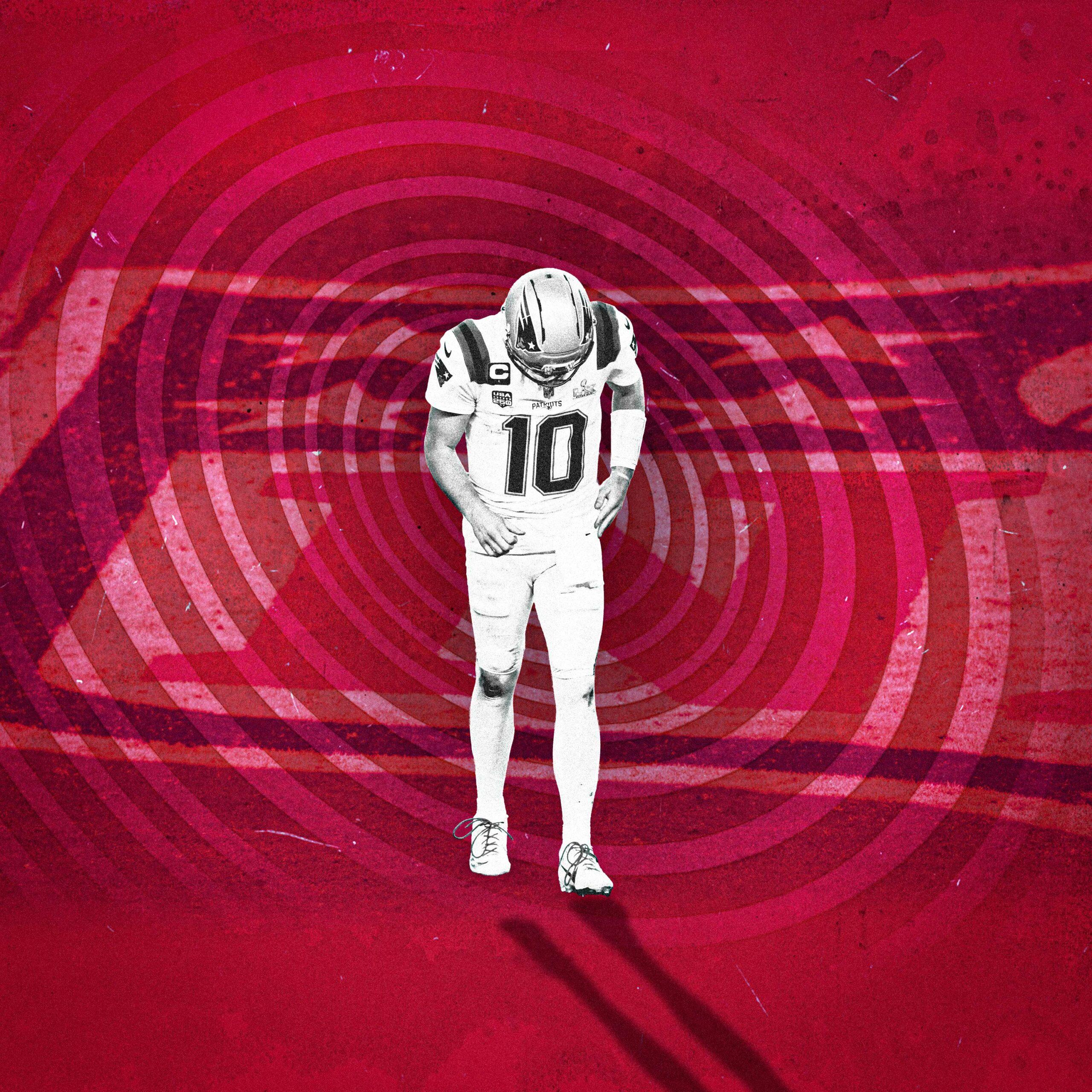

It was about 75 minutes after the clock hit zero on Super Bowl LX when Mike Vrabel stepped back into a nearly silent New England Patriots locker room. Vrabel had finished his formal media obligations, changed out of his sideline attire and into a mauve suit, and went to find his players. Only a dozen or so Patriots remained, a few stragglers pulling off their nameplates from atop the lockers, lacing up sneakers, and fastening watches. Vrabel walked from locker to locker, offering a quick handshake or hug to each of them.
Vrabel finished his lap of the locker room at Drake Maye’s stall. The second-year quarterback was the final player to change out of his game uniform, and he stood quietly with his back turned to the room as Vrabel approached. Vrabel reached to pat his quarterback on the shoulder, and Maye wiped his face. The two men leaned in close to talk for several moments before Vrabel gave Maye a quick tap on the butt and disappeared behind a curtain.
The quarterback seemed to need the extra encouragement after coming up far short in the biggest game of his young career. Maye threw for 295 yards with two touchdowns and two interceptions in New England’s 29-13 loss, but his final stat line hardly shows how ugly his performance truly was. The Patriots managed just five first downs on their first nine real drives (excluding a kneel-down at the end of the first half). New England’s offensive line struggled to handle Seattle’s pass rush from the outset of the game, and Maye never looked comfortable. It was like Maye’s internal clock was on the fritz. Early in the fourth quarter, Maye’s EPA per dropback ranked as the worst quarterbacking performance since 2000, per TruMedia, even worse than the Giants’ Kerry Collins’s in 2001. Despite some stat padding later in the fourth quarter, there’s no way around it: This was an all-time stinker.
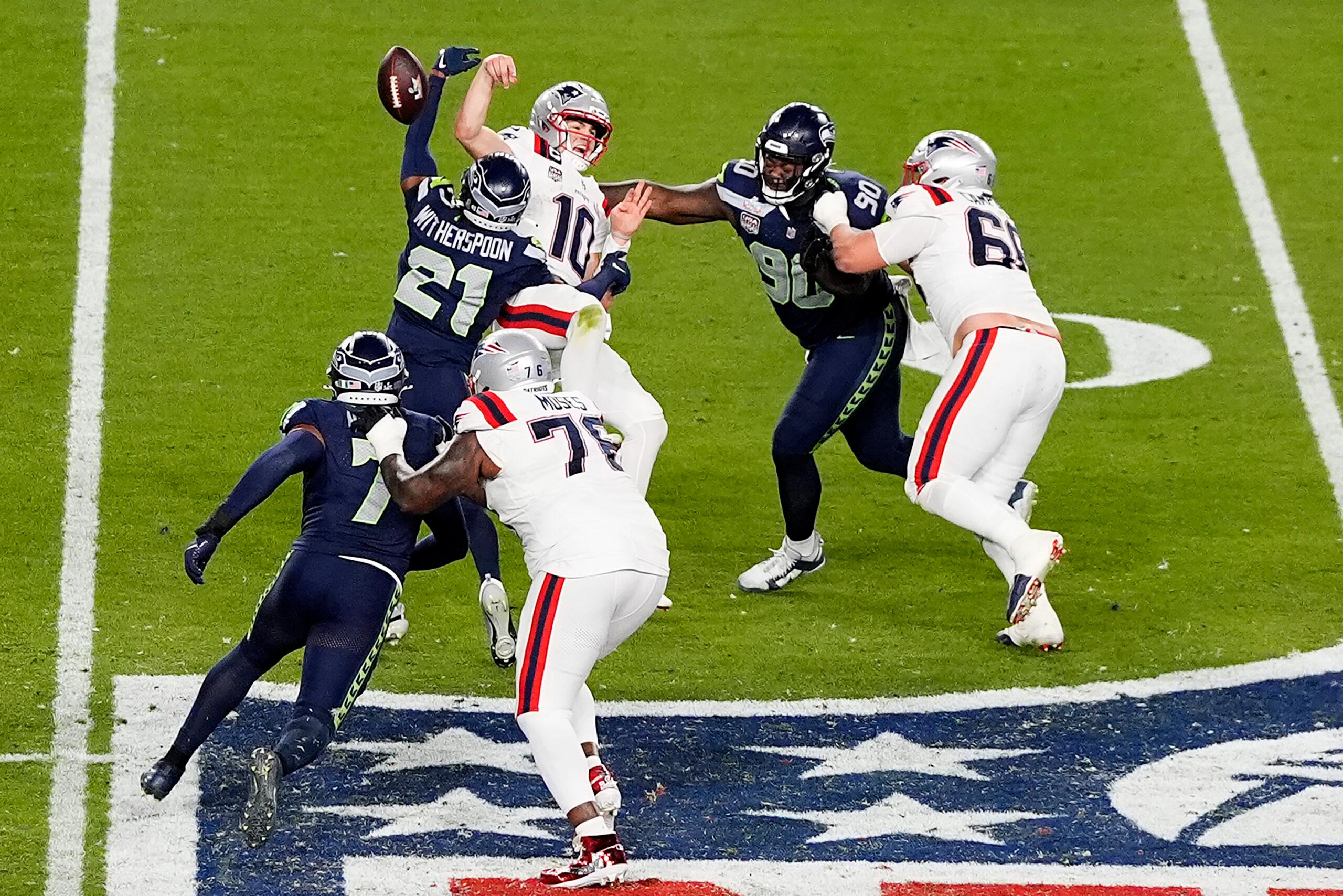
It was his worst performance by total EPA—by a considerable margin—and the third-worst game of his career by EPA per dropback. His turnovers were backbreakers, coming when the game was still relatively close in the fourth quarter. Maye had looked like he was finally settling down—he had hit back-to-back explosive throws with a touchdown to Mack Hollins to cut Seattle’s lead to 12 points at 19-7, and he was starting to drive the Patriots down the field again when he felt pressure from his blind side that forced him to step up in the pocket. But rather than taking a sack or looking for a quick, easy throw, Maye launched the ball downfield, seemingly without a clear intended target. The pass was doomed the moment it left Maye’s right hand, and safety Julian Love easily corralled the ball and returned it to New England’s 38-yard line. On New England’s next possession, Maye was winding up to throw when he was hit by two Seattle rushers, including blitzing cornerback Devon Witherspoon, whose pressure forced the ball out of Maye’s hand and into the waiting arms of linebacker Uchenna Nwosu. Maye was pancaked and lay flat on his back on the 45-yard line as Nwosu sprinted to the end zone for Seattle’s game-sealing touchdown.
“We can sit here and try to put it on one guy. You’ll be disappointed because that will never happen,” Vrabel said. “It starts with us as a coaching staff and making sure that we are doing our part, and then we have to be able to execute and got to be able to protect. When we do protect, we have to be able to progress through and throw the ball to the guy that is open and help the quarterback, and then he’s got to be better. That’s just how it goes, and that’s never going to change.”
By every possible measure, it was an all-around nightmare performance from Maye and New England’s offense. And yet, it shouldn’t have been surprising. The Patriots offense has struggled throughout the entire postseason against high-quality defenses. Each of New England’s four postseason opponents finished the regular season ranked in the top 10 in defensive DVOA. Its last three opponents, Houston in the divisional round, Denver in the AFC championship game, and Seattle in the Super Bowl, were in the top five.
But until Sunday, New England managed to survive on the strength of a defense that was peaking and forcing turnovers against a subpar run of opposing quarterbacks. Maye simply had to outduel the Chargers’ Justin Herbert, who had a broken left hand and was playing behind a decimated offensive line; Houston’s frazzled C.J. Stroud; and Denver’s backup quarterback, Jarrett Stidham. Throughout that run, it was possible for Maye and the Patriots to play conservatively—which was especially important in inclement weather during the Texans and Broncos games—and yet New England’s offense was still unimpressive. New England finished with a negative offensive EPA in each of its four postseason games.
But it’s hard to square such a disappointing performance in the Super Bowl with the quarterback Maye was for so much of the regular season. He finished second in MVP voting—with just one fewer first-place vote than winner Matthew Stafford—after emerging as one of the league’s most accurate and explosive passers, who was also capable of punishing defenses as a runner. He elevated New England’s mediocre group of skill-position players and routinely showed poise that belied his age (just 23) and lack of experience.
“Man, he’s literally been our MVP the whole season,” right tackle Morgan Moses said after the game. “The things as a young player in year two, it’s undeniable what he’s been able to do this season. You know, he put the league on notice that there’s a new young quarterback in the AFC that you’ve got to worry about.”
Plenty of other Patriots expressed similar sentiments about Maye in that quiet postgame locker room. Center Garrett Bradbury called Maye a “warrior” and the “leader of this team.” Receiver Stefon Diggs praised Maye’s fight and said his advice to his quarterback would be to channel Steph Curry and “just keep shooting.”
“He’s 23 years old, it’s a team effort, and, just coming from my standpoint, I wish I could have did more,” Diggs said.
The Patriots were a four-win team in Maye’s rookie season, and the quarterback’s massive second-year leap was the on-field catalyst that propelled New England to the Super Bowl. To a man, the Patriots players and coaches will admit that when this group assembled for its first practices under Vrabel last spring, and throughout training camp last summer, no one truly expected the season would end with a trip to the Super Bowl. In spending time around the Patriots last week, it felt like this was a group that knew it was at the start of building something special, but also that this team was essentially playing with house money. And to get blown out like this seemed to reinforce that the Patriots were simply a team ahead of schedule, not a championship-caliber contender.
“That’s the thing about life. You are going to have some times like this, and it’s how you bounce back,” Maye said. “I think that all those guys in the locker room are going to use this as fuel, and you go to war with those guys anytime, any day, anywhere. It’s motivation to get back here and not have this feeling and have what they are feeling out there.”
And yet it was like Maye was having to talk himself into a silver lining. When he returned from his press conference, still in his grass-stained football pants, several teammates approached to offer quick hugs and handshakes on their way to catch the bus back to the team’s hotel. And he was the player Vrabel sought out for a chat. Within minutes of Vrabel’s departure, Maye slipped on his sneakers and a white long-sleeved shirt, walked toward the back door of the locker room, and didn’t look back.