
When Stanley Kubrick released The Shining in 1980, he was dinged by critics for the film’s relentlessly roving camerawork; “It’s like watching a skater do figure eights all night,” sighed Pauline Kael. Her complaint was that the film’s director was merely idling, an auteur on autopilot. But as usual, Kubrick was ahead of the curve—he was laying the template for several generations of horror filmmakers to come.
Like the Overlook Hotel itself, The Shining’s style was built on a set of haunted foundations. In interviews, Kubrick invoked his fellow chess aficionado Jorge Luis Borges, whose spectral presence could be felt in the hotel’s corridors as surely as that of Stephen King. (Or maybe even more so, which was why King, who’s candidly described himself as the literary equivalent of a Big Mac and fries, was so pissed off by the final product.) “There is no need to build a labyrinth when the entire world is one,” observed Borges in his mind-bending short story “The Aleph,” about a point in space that contains and observes all other points, and The Shining unfolds in thrall to the paradoxical claustrophobia of the Argentine master’s worldview. Stan’s labyrinth featured meticulous production design by Roy Walker—floridly color-coded decor and fearful symmetry—and hypnotic cinematography by John Alcott, who mapped that sprawling, made-to-order maze in real time. In lieu of gothic shadows, Kubrick and his collaborators conjured up a sterile, fluorescent fugue state, fusing physical and psychic terrain into a series of winding hallways leading back and forth in time.
It’s unclear whether or not Kane Parsons, the 20-year-old director of Backrooms, has read Borges, although references to “The Aleph” are scattered through the lore of the Backrooms anthological web series that he first wove together out of Reddit threads in 2022 before getting tabbed by A24 to turn it into a feature. Chances are pretty good that he’s watched The Shining or, at least, per the recent confessions of his fellow prodigious up-and-comer Curry Barker, seen the episode of The Simpsons based on The Shining, which serves as well as any other piece of homage or satire to distill its aesthetic power and cultural impact (“Shhh! You want to get sued?”). Actually, there’s another Shining homage that pertains even more closely to Backrooms: the jaw-dropping, stomach-churning scene in Steven Spielberg’s Ready Player One wherein a troupe of video gamers invades a VR version of the Overlook via their stylized avatars, trading anecdotes about the movie’s lore (cue Room 237 jokes) and rampaging through a photorealistic re-creation of Kubrick’s mise-en-scène. Sacrilege or satire, take your pick; either way, the sequence is vivid as a vision of Zoomers running victory laps around the classics.
Parsons is a gamer: He was raised on puzzle-platform titles like LittleBigPlanet and Little Nightmares and has talked about his love for Portal and Portal 2, which tracks. He also claims to be a big fan of Peter Watkins's Punishment Park, a scabrous social satire about antiestablishment activists being hunted for sport by bloodthirsty national guardsmen in Nixon’s America. Maybe the kids are all right after all.
The obvious novelty of Parsons’s Gen Z pedigree, and his triumphal positioning as the youngest filmmaker to ever helm a studio production—leapfrogging John Singleton, Brian De Palma, and Orson Welles in the process—is a load-bearing component of the Backrooms hype. It’s also a double-edged sword hanging over the film’s potential reception, especially when it comes to hardcore horror enthusiasts caught between wishing long life to the new flesh and performing wariness of industry plants springing up in their midst. (Exhibit A: the wildly polarized reactions to Obsession, which are in sync with the intensity of the film itself.) The only thing more dangerous than plunging headlong into the social media discourse du jour is dismissing it out of hand, and in a moment when a band as obviously talented as Geese can be plausibly debated as a psyop, it tracks that a filmmaker like Parsons, who makes a habit of pointing out that he’s actually younger than YouTube itself (he was born on June 5, 2005, two months after the initial upload of “Me at the Zoo”), is sure to be a lightning rod for envy and skepticism.

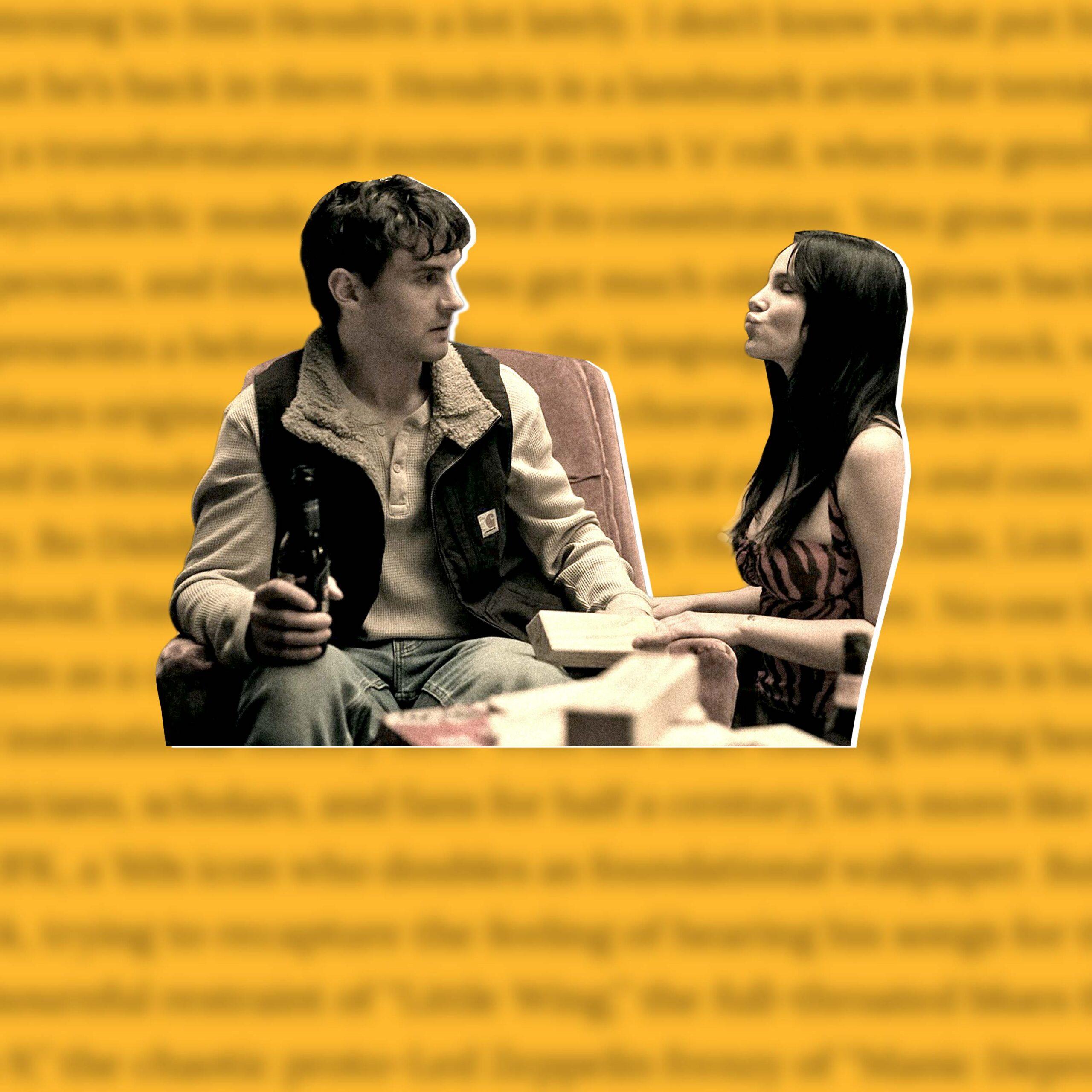
There are plenty of opportunities for both, whether it’s prodding the validity of Parsons’s authorship (see the recent “ghost director” controversy on social media, which started as a joke and escalated to the point where Mark Duplass felt obliged to shut it down), the possible scope of his success (industry projections are predicting a $40 million opening weekend), or the originality of his artistic vision. The latter is ironic insofar as one of the lurking, not so elusive themes of Backrooms—a movie that doesn’t lack for entry points—is the postmodern terror of reiteration without end, the unsettling and melancholy notion of reality as a series of adjoining, subterranean echo chambers, each a slightly altered copy of the last. “Six hundred million square miles of randomly segmented back rooms,” read the original, anonymous, and extremely viral 4chan post that ended up being used as a blueprint by hordes of online architects eager to build their own additions onto a freestanding urban legend; the sprawling, relentlessly subdivisional logic of this online lore, and the fact that anyone could contribute to it at any time, turned the expanse of the Backrooms into a pretty nifty allegory for itself.
Parsons was 16—and going by the online handle Kane Pixels—when he made his first Backrooms short in 2022: a found-footage-style clip created in Blender and After Effects. His innovation was to place the preexisting images into a paranoid narrative framework about a research facility offering egress to another dimension; the first clip centered on an amateur filmmaker who gets lost in the Async complex and chased by an unseen creature. The 1995 setting hearkened back to an analog era that Parsons longed to visit vicariously—a bit like Paul Thomas Anderson staging a tribute to the ’70s porn stars he’d have been too young to ogle in real life. A 2024 profile in Dazed referred to the director as having “David Cronenberg’s brain on Ninja’s shoulders,” which may have been a little much but got at the appeal of his output. The Backrooms shorts cleverly leveraged tactile, VHS-era nostalgia against glitchy digital ephemera, and also mock-documentary urgency against the immersion of open-world video games: The Blair Witch Project by way of Silent Hill, with a subtext of alienated labor right out of The Office. The latter influence has come full circle: Dan Erickson has cited Backrooms as an inspiration for Severance.


In 2024, it was reported that the primal scene of the Backrooms was actually a water-damaged furniture store in Oshkosh, Wisconsin, that had been photographed in the midst of renovations. Not exactly the stuff of H.P. Lovecraft, perhaps, but nevertheless suggestive in light of how the vast majority of Backrooms-branded memes and creepypastas were disseminated—and duly intellectualized—under the auspices of either analog nostalgia or social critique. “Backrooms are a new horror genre weaned on the aesthetics of post-capitalist liminal space and the pervasive anomie in today’s global society,” writes Rosa A. Cruz in an excellent essay that gets at the Freudian uncanniness latent in the imagery, the sense of the familiar made strange and also vice versa. The Backrooms are unremarkable: quotidian, institutional, functional. But they’re also lonely and abject and disfigured around the edges: jaundiced, shag-carpeted twilight zones. Their purgatorial spaciousness makes them a perfectly (un)natural habitat for all sorts of personal or allegorical projections.
“I think the Backrooms is very much a reflection of the broader economic and industrial trends that have brought about this very tangible box that a lot of people feel an anxiety of being placed in,” said Parsons in an interview with The Au Review. It’s an articulate summation, pressurized by tangible anxieties of a different kind. That Parsons has gotten the bag doesn’t mean he isn’t worried about being put in his own box. The question of whether Backrooms is simply a reflection of broader economic and industrial trends in the horror arena—another fluke YouTuber in the content-creator-to-development-deal pipeline—or whether it succeeds in genuinely transcending them is tricky. That’s partly because the boundaries between the film’s multiauthored source material and viral marketing tactics are so scarily permeable, and partly because Parsons’s actual filmmaking is somehow both more accomplished and less effective than one might expect. Backrooms is extremely well made within its limitations even as it exposes them; it exists in its own liminal space between ambitious experiment and fascinating failure.
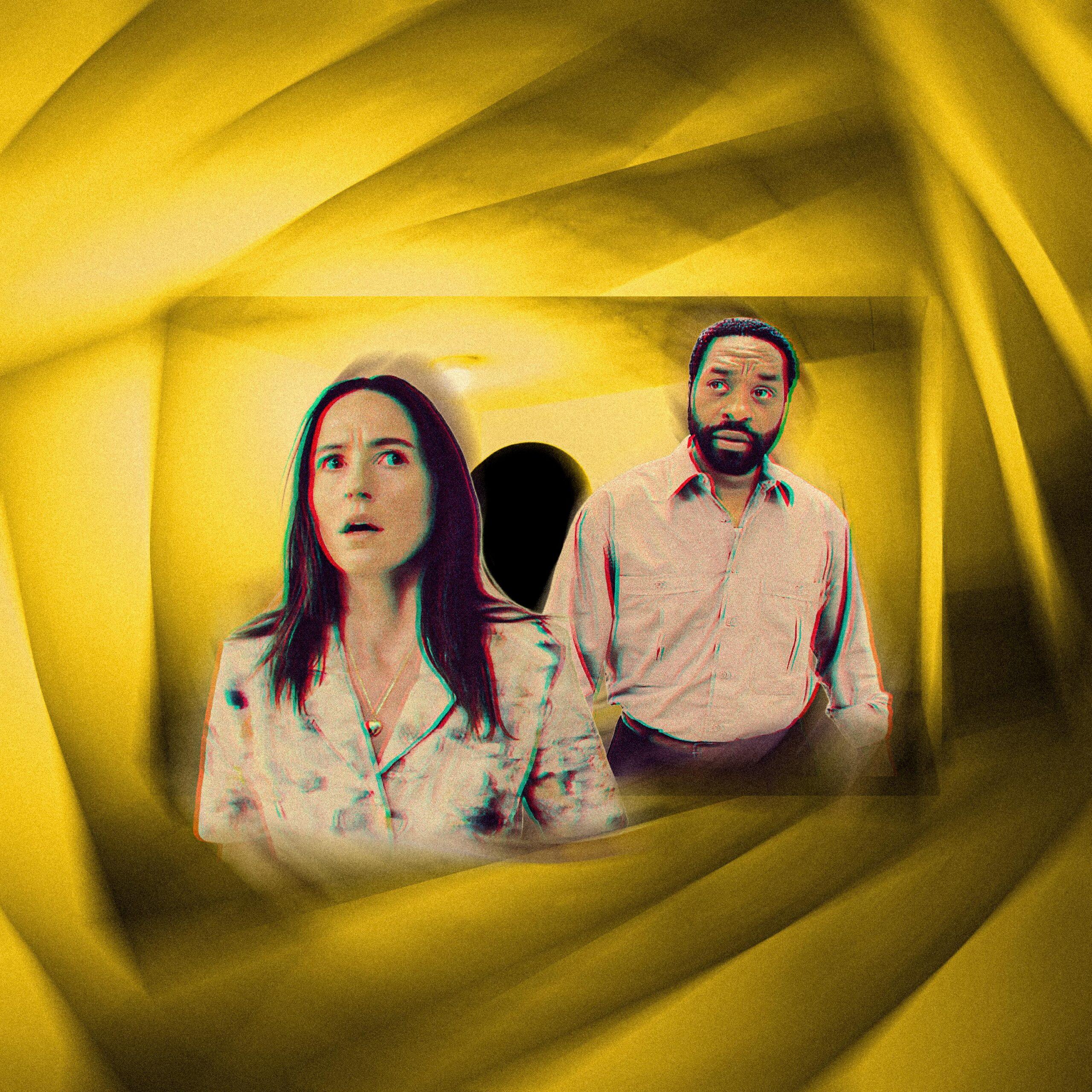
It’s telling, perhaps, that Will Soodik’s screenplay foregrounds frustration as a theme. The protagonist is a stymied architect, Clark (Chiwetel Ejiofor), who’s reduced to managing a discount furniture store in the Santa Clara Valley circa 1990. At the beginning of the film, he’s living in the showroom of what has confusingly been dubbed Captain Clark’s Ottoman Empire. A generous critic might propose that the clash between pirate and Persianate aesthetics in Clark’s homemade promotional videos—in which he dons a peg leg while comparing himself to a sultan—hints at the temporal incoherence to come. Clark is separated from his wife and drinking heavily; his only outlet for catharsis is weekly sessions with a therapist, Mary (Renate Reinsve), who encourages role-play and asks him to take accountability for his actions. Where Clark is defined by his store’s forlorn simulacrum of domesticity, Mary’s curiosity and perceptiveness—and her own desire for escape—are suggested by the title of her book: The Window Within.


Clark finds a window, all right—or rather a doorway—embedded in a blank, porous section of the drywall in the store’s basement. (He discovers it by accident while fiddling around with the electrical panel; the glimmers of light bleeding through the gypsum and illuminating the passageway make for a memorably eerie early image.) After a few solo forays into the Backrooms, when he starts mapping the area’s dimensions and hears but does not see evidence of other occupants, Clark recruits a pair of minimum-wage employees (Finn Bennett and Lukita Maxwell) to help out with a filmed expedition. Suffice it to say that it does not go well, and also that Mary—whom Clark had briefly told about the Backrooms, and who otherwise seems to spend her time mournfully flashing back to an unhappy childhood spent shut in with her mentally ill mother—resolves to go looking for her disappeared patient.
Up until this point, about a third of the way into the film, Parsons is in relatively familiar territory. He may be young, but he’s already a veteran of strategic withholding, and when Clark and his team start exploring, we might as well be in one of the original lo-fi shorts—except that there’s occasionally an Academy Award nominee visible within the bobbing, handheld frames. Where Parsons has to take a leap—and where he swiftly loses his footing—is in showing us what is actually happening in the Backrooms, which has little chance of living up to several years’ worth of carefully cultivated ambiguities; the revelations are somehow too much (stilted, clichéd dialogue) and not enough (a lack of real scares).
That Parsons is trying to place his opus above cheap jolts is fair enough. This is a less assaultive viewing experience than Obsession, which really does a number on the audience (exemplified by a certain notorious set piece testifying, with a smirk, to Barker’s blunt-force approach). But his restraint also points up a certain lack of ruthlessness or killer instinct. Horror cannot live on vibes alone, or else said vibes have to be immaculately bad: rancid, unsettling, unfathomable. Take, for instance, Kyle Edward Ball’s Skinamarink, which threads a similar strand of analog nostalgia through a murky, nocturnal child’s-eye perspective; its plotting is even vaguer than that of Backrooms, but the fears it accesses are simultaneously more universal and more precise. Parsons never works up the compulsive terror needed to justify all the surrounding obliqueness—not even with Ejiofor in good form and Reinsve doing her best to look freaked out while being pursued by what looks like a reject from The Amazing Digital Circus.
On a purely technical level, the Backrooms are an architectural marvel: 30,000 square feet of soundstage space in Vancouver, re-created to the last pixel using digital previz and tricked out with ingenious practical FX. Still, as an excursion into purgatory, Backrooms isn’t as rigorously structured as Genki Kawamura’s recent video game adaptation Exit 8, and after a while, the piles of disused furniture lose their threatening aura. There’s nothing here as indelible as the graffiti-streaked apartment complex in Bernard Rose’s Candyman, or Kiyoshi Kurosawa’s dilapidated warehouses, or the Overlook Hotel; the visceral and emotional stakes here lie not with the characters and their fates (as they do in those movies) but with something beyond the frame—that is, whether the gifted kid behind the camera is able to stick the landing.
He doesn’t, and that’s OK: Like the Backrooms themselves, Backrooms will surely be interesting as a subject for further research. It’s definitely open to interpretation, depending on which pathway you want to follow: Captain Clark’s Ottoman Empire as an emblem of American decline, the Backrooms’ strangely deformed inhabitants as a symbol of AI’s inherently degraded forms of representation. Parsons’s reluctance to wander too far in any one direction—literally or figuratively—into his own painstakingly rendered milieu seems like a practical decision made on behalf of potential sequels rather than a sign of the narrative being steered toward its logical (or satisfying) end point. For all of Backrooms’ very real formal control, it’s ultimately and strangely indecisive. Instead of punctuating the action with a question mark, it leaves off with a shrug. (Say what you will about Obsession, but it’s not a movie you shake off; it leaves residue, even if it’s sleazy.) The final image of Parsons’s film is meant to suggest the grimly self-divided nature of one of his main characters; it’s striking, even if it doesn’t have much force. What it illuminates, like the light bleeding through Clark’s walls, is something else: the thin but real fracture between intention and achievement, between a movie that means to contain multitudes and one that’s somehow less than the sum of its myriad and intricate parts.