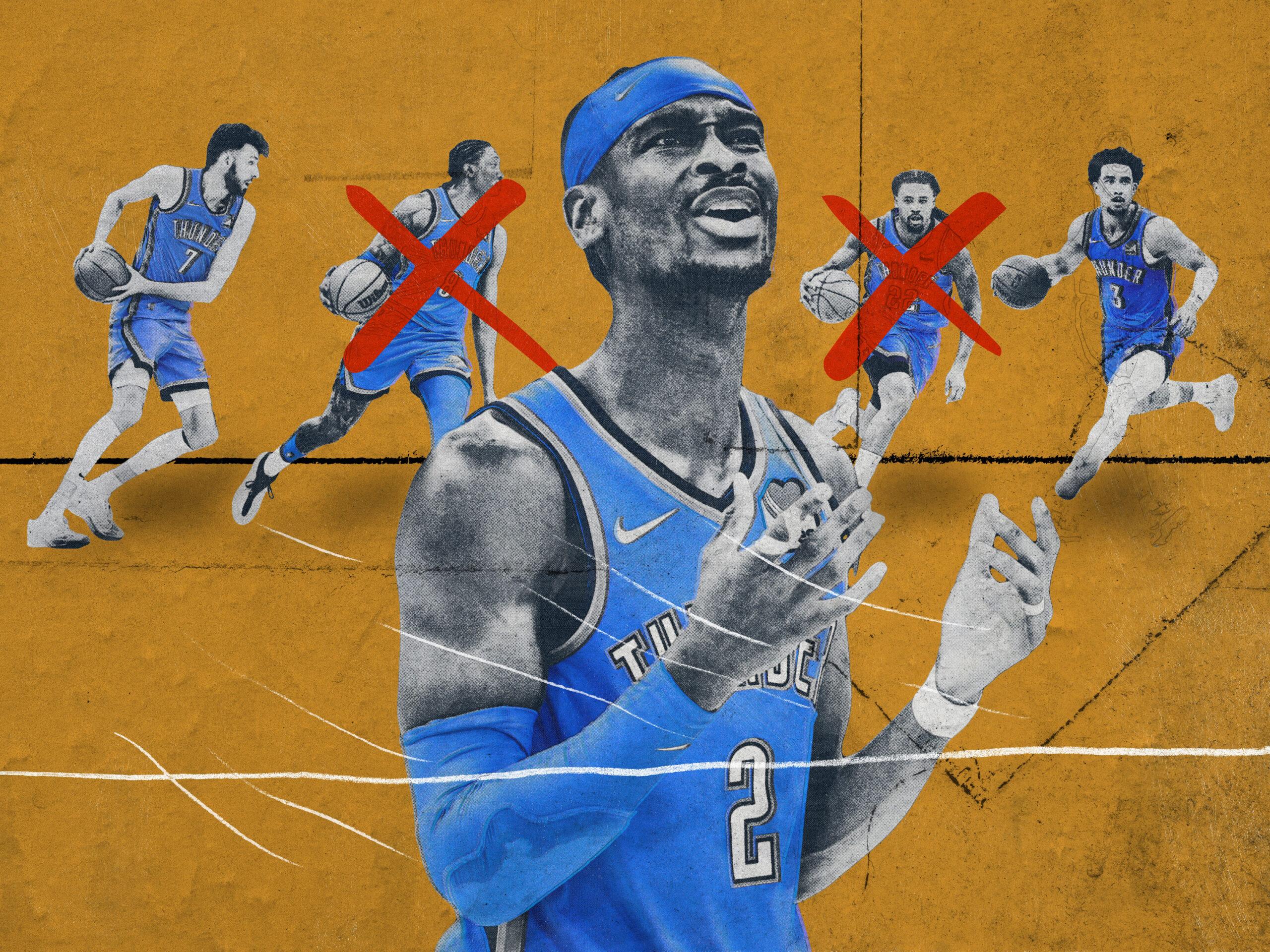

It was the most exhilarating sequence of the Thunder’s young season: Chet Holmgren taking the form of an airborne obelisk for a two-handed block in a momentum-shifting play against the Nuggets in the third quarter, creating a moment of disorder that allowed Cason Wallace to take possession, march down the floor, and deliver a perfect, hooking alley-oop pass to a storming Jalen Williams. What a moment of terror and exultance. It was an encapsulation of the juggernaut that Oklahoma City has created over time through luck, patience, and struggle.
Less than a week later, it feels like a divination from another timeline we weren’t meant to access.
Not one of those three Oklahoma City players was available for the Thunder’s 125-114 win against the Phoenix Suns on Monday night. Earlier that day, general manager Sam Presti effectively confirmed the existence of Murphy’s law: two potentially season-ending injuries, just six days into an 82-game regular season. Williams was set to remind the world just how integral of a star he is for the team when healthy, before he broke his left fibula and dislocated the adjoining ankle in a gruesome injury. Wallace was just a week removed from signing a five-year, $139 million extension before tearing the labrum in his left shoulder. If that weren’t enough, Holmgren sat out on Monday to manage a flare-up of right knee tendonitis and will also be out on Wednesday—what seemed like a routine rest day might become a persistent issue of load management.
It’s been one of the most dispiriting starts to a season in recent memory between the Thunder’s litany of injuries, and stars like Anthony Edwards, Paolo Banchero, and Jaren Jackson Jr. all set to miss significant time. The Thunder’s season is far from over, but whatever vision of the team that two-way sequence conjured now lies dormant. It’s frustrating; it’s increasingly the nature of basketball. To quote a hoop prophet, Why the fuck would you show me something if I couldn’t have it then?
This isn’t Presti’s first season from hell. The procession of early-season injuries calls to mind OKC’s snakebitten 2014-15 season, which saw Kevin Durant, fresh off an MVP-winning season, missing the first 17 games of the season while recovering from a Jones fracture in his right foot and playing in just 27 games before being shelved for the entire season to have season-ending bone graft surgery. That same year, Russell Westbrook missed nearly all of November with a fractured right hand. I’ll always remember Perry Jones stepping into the gaping void valiantly for three games … before suffering a knee injury that also took him out for most of November (and essentially ended his NBA career). It was the only season in a full decade spanning 2009-10 to 2019-20 wherein OKC did not qualify for the playoffs.



Things don’t look quite as dire this time around. For starters, the Thunder still have arguably the best player in the world, Shai Gilgeous-Alexander, standing upright, and Presti has amassed enough insulation to stay both competitive and flexible should there be a need for roster retooling before the trade deadline. But like in 2014, the hits keep coming. Just hours after Presti delivered the somber update on Williams and Wallace, Alex Caruso sprained his ankle contesting a shot from Dillon Brooks just before halftime on Monday; Ajay Mitchell, the star of their win over the Suns, seemed to have tweaked his ankle on a drive in the second half, though it did not prevent him from having a career night.
In an emotionally charged game where everyone in the Paycom Center needed a bit of reassurance, the team and its fans alike were able to divert their attention away from what’s been lost and key in on a breakout star waiting in the wings. Most teams would be decimated after losing two starters; the Thunder aren’t most teams. Mitchell was a revelation on both ends of the floor against the Suns, scoring a career-high 30 points. (He’d retained his place as a top-75 player in The Ringer’s Top 100 rankings over the offseason for a reason.) The third-year guard relentlessly snaked his way into the lane, drawing fouls and finishing tough touch shots over bigger defenders. He’s already cultivated strong pick-and-roll and dribble-handoff chemistry with both Isaiah Hartenstein and Aday Mara; that synchronicity, coupled with Mitchell’s SGA-influenced stop-start cadence, gives OKC the luxury of having an elite driver on the floor at all times, even in its depleted state. On defense, Mitchell channeled teammates past and present, taking advantage of his noticeably stronger build this season by bodying up and literally ripping the ball away from physical wings like Brooks and Devin Booker and fighting over screens at the point of attack.
For a player suddenly tasked with a much larger creation burden, Mitchell never lost sight of doing the little things: cutting away from the ball, boxing out to allow his bigs to secure boards, being an attentive helper at the nail. Teams are programmed to have a next-man-up mentality, but it’s a testament to the Thunder ecosystem that Mitchell was immediately empowered and able to scale up his usage across the board. His path to where he is today follows a lineage, a scouting motif of sorts. As they did with Williams before him, the Thunder saw something special in a player who was excelling in the shadows of a West Coast mid-major; like Gilgeous-Alexander, Mitchell has a preternatural ability to get to his spots and finish around the rim with touch—the perfect foundation to build on. All three players went from unheralded to undeniable. The Thunder have certainly given themselves as many chances as possible to find diamonds in the rough, but it’s easier to hit it big when you know exactly what you’re looking for. In the 24 starts he’s had since last season, including the playoffs, Mitchell has averaged 16.3 points per game (on 49/38/89 shooting splits), 3.6 rebounds, and 4.1 assists—not all that dissimilar to J-Dub’s career averages. (Mitchell is listed as questionable for Wednesday’s game against the Mavericks. Of course he is.)
The rest of the Thunder’s season will be a protracted exercise in holding multiple truths at once. OKC is one of only two teams in NBA history to start 4-0 in three consecutive seasons; it is also in the throes of trying to survive a basketball apocalypse. Given the scourge of early injuries leaguewide, the Thunder will once again present as the NBA’s ultimate case study in team dynamics. This time last year, we were wondering whether OKC could break the single-season wins record. The context of this season has shifted toward managing scar tissue, toward survival. There is no use waiting for or wondering about what the team will look like at full strength because it’s unlikely to present itself: J-Dub's and Wallace’s long-term recoveries are front of mind, but the team will also have to manage Holmgren’s knee inflammation over the course of the season. Tendonitis gets better only with adequate rest, and that’s time that OKC can’t afford to spend and can’t afford not to. You could construct a starting lineup that would be the envy of half the league just from the Thunder’s injury report for Wednesday’s game; Oklahoma City could be down four of its top six leaders in on-court net rating from last season.
But unlike the Timberwolves, who are now being confronted with the reality of playing without Edwards for the next two months, the Thunder can still coast on the greatness and consistency of SGA while they find the right spackle to patch the walls. Mitchell has already shown he has the stuff of demi-stardom. Hartenstein and Mara (now looking like the only pick the Thunder could have made at no. 12) may not be as dynamic as Chet on either end of the court, but they offer enough size to defend the paint and enough wheel greasing to be lob targets and part-time playmaking hubs. Jared McCain and Bennett Stirtz (the 16th pick in last spring’s draft) become Gemini marksmen with the secondary playmaking instincts to keep the offense spaced out and dynamic.
The Thunder have an interesting conundrum on their hands in terms of how to keep moving forward. Promoting the rookies from the playpen to the bullpen has its merits given how the Thunder have operated over the past few years. The team has been a 1-seed for the past three seasons yet is still one of the 10 youngest teams in the league, and that works only if you trust your young guys. But it also makes sense—now, more than ever—to make the kind of trade that less than a handful of other teams have access to. OKC still has more future first-round picks than most teams in the league; if stockpiling assets all these years was meant to create a rainy-day fund, what better time to cash in than when you’ve been hit by a tidal wave?
Somehow, the kind of player the Thunder truly need to keep this season afloat is the kind of player that they’ve turned into an emblem over the years: an agent of chaos who can create havoc on defense. Caruso is the archetype, the patron saint, but he also has yet to play more than two-thirds of a regular season in Oklahoma City. They don’t need a replacement, but their model of success requires replicants. Kris Dunn has been an absolute demon in Los Angeles to start the season; would the locked-out-of-heaven Clippers part with his expiring contract for some much-needed draft capital? Could the Grizzlies be talked into parting with one of their bench tweeners (Kris Murray, GG Jackson, Olivier-Maxence Prosper, Taylor Hendricks) now that they’ve moved into a new era?
OKC doesn’t necessarily have to take a big swing at this juncture; considering how many players it’s down, there might not be a bigger compliment to what the team has built. Of course, Presti has never approached roster construction as an all-or-nothing play on the present, but he also knows the franchise is in a race against the spiked walls of the second apron, closing in on the inherently finite nature of a championship window. Two seasons ago, the Thunder achieved immortality by revolutionizing the accelerated timeline, ironically built around an all-time braking system. Now, they’re facing a sort of existential whiplash.