
Dante Moore

Experience
POSITION STATS LAST SEASON

Position-Specific Grades
MEASURABLES
The Takeaway
The Player
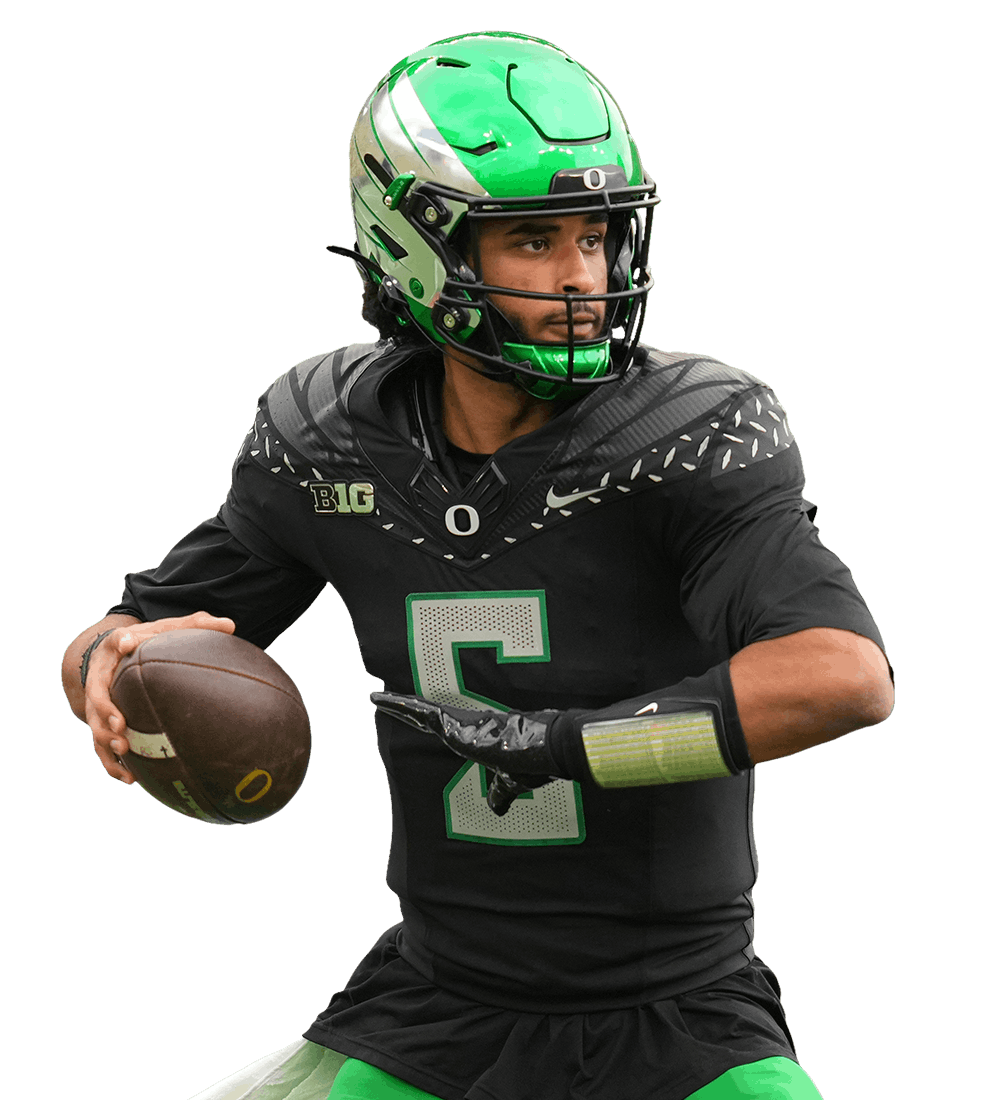
After winning the starting job at Oregon in 2025, Moore led the Ducks to a 13-2 record while completing 71.8 percent of his passes, with 30 touchdowns and 10 interceptions. He enters his second full season as Oregon’s starter in 2026, this time under new offensive coordinator Drew Mehringer after Will Stein accepted the head coaching job at Kentucky.
On the field, he’s one of the most naturally gifted pocket passers to enter the draft in recent years. His greatest strengths are his timing, anticipation, touch, and ball placement. He consistently throws with outstanding timing on back-shoulder routes and leads receivers beautifully across the middle of the field. Just as importantly, he throws an exceptionally catchable football. Receivers rarely have to adjust or fight for passes because Moore consistently places the ball where they can transition smoothly into yards after the catch.
While he doesn’t possess the elite arm talent of Matthew Stafford, Josh Allen, Patrick Mahomes, or Justin Herbert, Moore generates more than enough velocity to attack every area of the field. He drives deep outs with confidence and effortlessly pushes the ball vertically. His anticipation, timing, and placement more than compensate for his lack of truly elite arm strength. He’s also highly effective throwing on the move, particularly when rolling to his right.
His biggest area for improvement is how he handles interior pressure that compresses the pocket. Several of Moore’s poor decisions and costly off-target throws in 2025 came when defenders closed in directly in front of him. Even so, his overall pocket presence is a strength. He senses pressure well, understands when to climb or slide, and uses his quick feet and agility to extend plays. Although he’s athletic enough to escape trouble, he’s more of a functional runner than a true dual-threat quarterback. He reportedly ran a 4.9-second 40-yard dash in high school but appears closer to the 4.7 range on tape. He’s not slow, but he’s unlikely to be a significant running threat at the next level.
The Projection
Rinse, refine, progress—that’s Moore’s mission in 2026.
This is his first offseason returning as an established starter, so it’s reasonable to expect that, even with a new play caller, he’ll be sharper with his reads, be more instinctive with his pocket movement, and experience fewer of the rattled moments that surfaced during his first full season as a starter in 2025.
From an NFL comparison standpoint, I see a lot of C.J. Stroud in his game—but Moore’s ceiling is even higher. Moore shows more creativity in the pocket while possessing similar, if not more promising, pocket passing ability. Like Stroud, Moore will still be shy of his 22nd birthday when drafted next April, and he’s on track to enter the league with nearly as much starting experience as Stroud had when he left Ohio State for the NFL.