
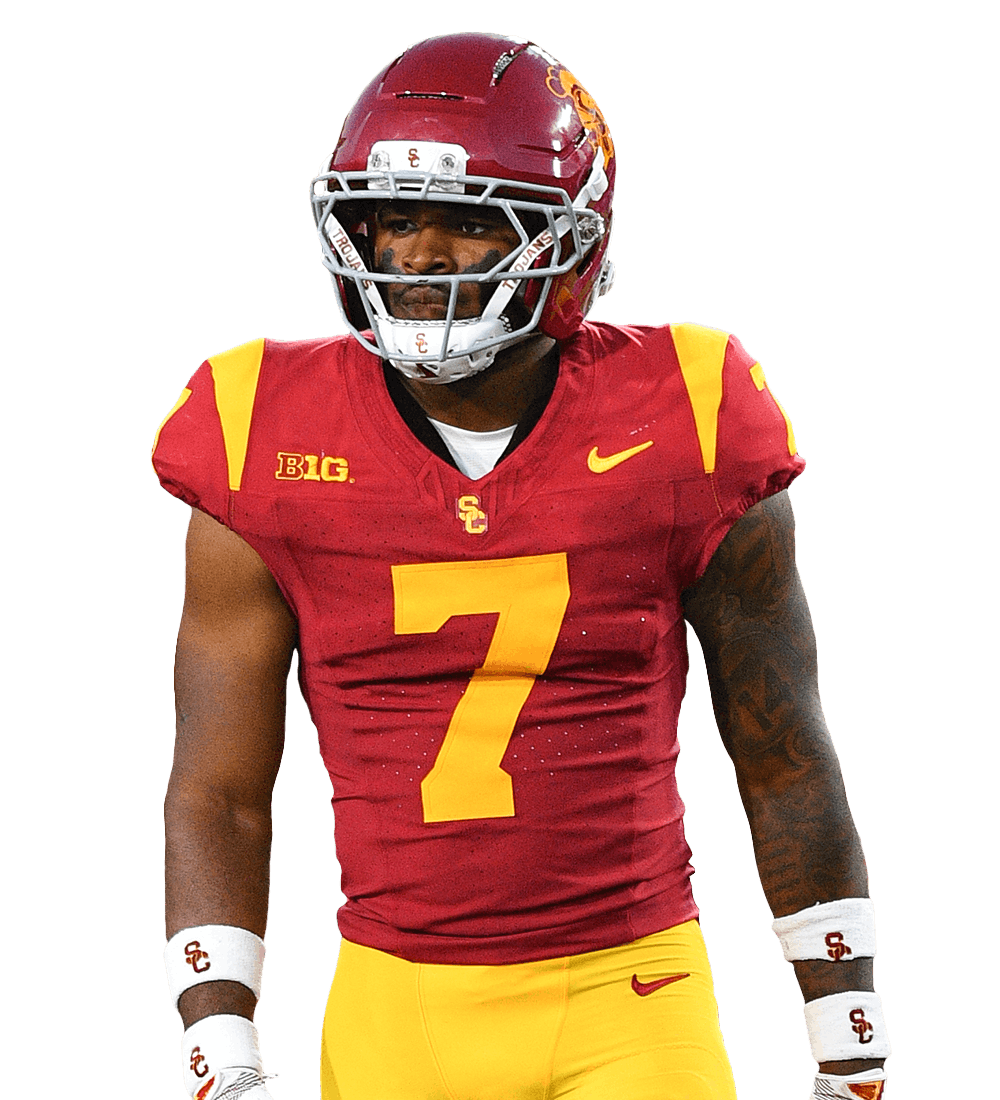
Kamari Ramsey

Experience
POSITION STATS LAST SEASON

Position-Specific Grades
COMBINE RESULTS
The Takeaway
The Player
Ramsey is a versatile, instinctive safety with good size and speed. He reads receivers and gets his eyes on the quarterback. In off coverage, he closes well on in-breaking routes and is able to flip his hips and stay in phase when receivers try to run past him. In press coverage, he can reroute receivers and stay in phase. He takes good angles and flashes the ability to recover when caught out of phase. He’s competitive enough to match up with tight ends and can step in front of receivers when he drops to hook/curl. He quickly triggers and can beat blockers to the point of attack on quick-hitters.
He has below-average arm length, which affects his ability to get his hands on passes even when he’s in a position to make a play. He had just two passes defended in 2025 and 11 total over the past three seasons. He doesn’t time his jumps well. He’s a good runner, but he doesn’t have the range or length of a true center fielder. He had only two interceptions in his college career and none last season.
He chases with good effort and limited the amount of missed tackles in run defense last season. He flashes the ability to play off blocks but still struggles to get free at times and lacks the size or length of a box safety. He primarily played over the slot in 2025. Over his college career, he lined up at free safety for 728 snaps, over the slot for 556 snaps, and in the box for 364 snaps, according to PFF. He played for UCLA for two seasons before transferring to USC in 2024. He missed the last three games of the 2025 season with a knee injury.
The Draft
Ramsey is a top-10 safety and a potential top-100 pick in this class.
The Projection
Ramsey will likely start his career providing depth at safety and at nickel. Malaki Starks, a 2025 first-round pick, is quicker and has longer arms, making him an imperfect comp, but there are shades of Starks’s game in Ramsey’s. Both are versatile safeties with similar sizes and top-end speed. There’s also a strong argument that both were better as sophomores than as juniors in college.